Using radio telemetry and accelerometry to evaluate factors influencing Chinook salmon (Oncorhynchus tshawytscha) migration behavior during recolonization of newly accessible habitat following dam removal in the Klamath River
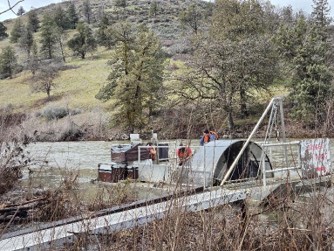
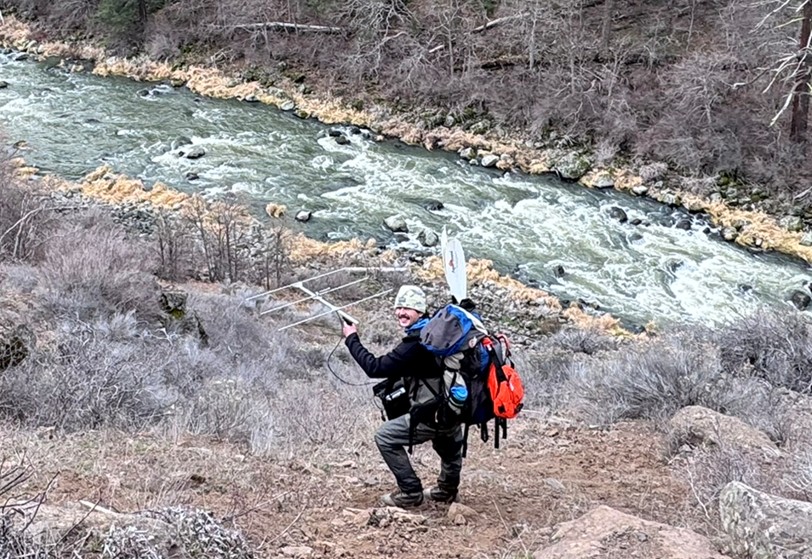
This master’s thesis project is integrated within a collaborative group consisting of over 20 organizations working together to monitor, study, and support the recovery of anadromous salmonids in the Upper Klamath Basin following the removal of four dams. The group uses radio telemetry to track the movements of adult salmon and steelhead into over 400 miles of habitat now available for the first time in a century. As salmon return to the Upper Klamath Basin, full expansion into these reconnected habitats would require migrations of nearly twice the distance and elevation needed to reach the most downstream former dam. Focusing on fall-run Chinook salmon, the thesis aims to quantify how biological attributes of fish, water quality conditions, and geomorphic features influence migration extent and behavior.
The research applies hidden Markov models to telemetry-based movement data and activity data from accelerometers embedded within the radio tags. These complementary data streams enable fine scale, continuous inference of behavioral states which we classify as holding or active migration. The model incorporates covariates including sex, lipid content, temperature, flow, diel and seasonal timing, and physical characteristics of reaches (e.g., Keno Dam) to quantify how these factors drive holding and migration behavior. Given a limited energetic budget, understanding how these factors shape migration patterns offers insight into the capacity of recolonizing individuals to undertake extended upstream migrations and the degree to which migration conditions support or limit dispersal.
Research to inform improved juvenile salmon habitat models: estimating factors associated with variation in cover elements.
River discharge shapes the amount of suitable habitat available to juvenile salmon throughout the year, and habitat availability in turn drives density-dependent processes like foraging, predation, and territorial behavior. These processes affect fish size, which influences survival and overall abundance. Instream structural cover, such as boulders and large woody material, is a key habitat feature that offers juvenile salmonids protection from predators, hydraulic shelter, and visual isolation from competitors, shaping their growth, spatial distribution, and survival. As distance to cover increases, the probability of juvenile salmon occupancy and abundance decreases. Thus, knowing the distribution and area of cover in a river system is critical information for improving juvenile production models like the Stream Salmonid Simulator (S3). Yet the distribution and total area of available cover remain poorly quantified, particularly in large, turbid rivers like the Klamath River, and cover availability shifts with flow levels that are often regulated by dams.
This study develops a spatially explicit, discharge-dependent model of instream cover distribution and total area across the mainstem Klamath River. Side-scan sonar surveys are used to map inundated cover, while topobathymetric LiDAR-derived land cover and elevation data identify exposed structural features across a range of flows simulated by 2-D hydraulic models, capturing when exposed cover becomes wetted and available for use. Because it is infeasible to survey the entire river with traditional habitat surveys and sonar, we are also developing a predictive model that estimates cover distribution and area at varying flows using geomorphic and physical characteristics such as channel slope and valley confinement, allowing predictions to extend to unsurveyed reaches. The resulting model will provide updated, spatially explicit estimates of juvenile salmonid cover area and availability, supporting science-based flow management and restoration decisions by refining the habitat component of S3 for the Klamath River.
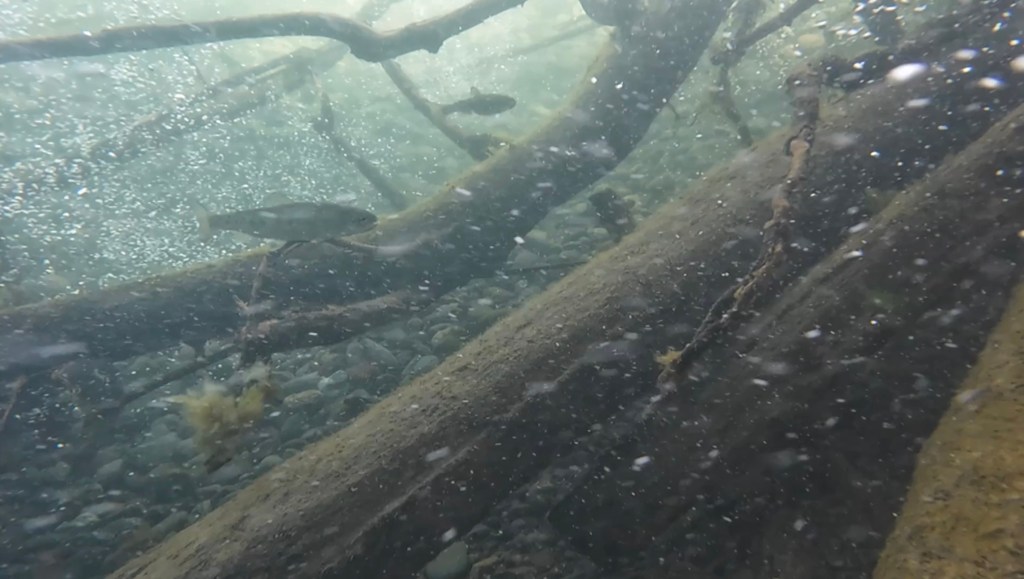

Benthic Macroinvertebrate Succession, Streambed Disturbance, and Marginal Habitat Inundation Under Seasonal Flow Releases from the Trinity River Diversion
Kendall’s project is designed to address knowledge gaps about the fundamental goal of the Trinity River Restoration Program to restore the function of the Trinity River. His research examines how flow management influences aquatic insect communities and the food web that supports juvenile salmon in the Trinity River. He aims to quantify recolonization or colonization of benthic macroinvertebrates in disturbed areas of the perennial channel and seasonally inundated areas above a winter baseflow elevation, which is contrasted with perennial wetted areas. Through his work, Kendall is interested in understanding how the physical processes that shape rivers influence the organisms that live within them, and how ecological research can help guide restoration.
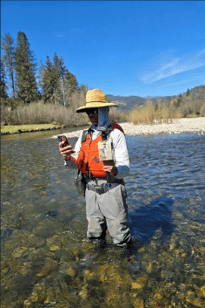
Evaluating environmental DNA for monitoring anadromous fish at SONAR stations
Objectives: Evaluate environmental DNA (eDNA) as a monitoring tool for anadromous fishes through direct comparison with conventional methods by (i) comparing species detections between paired tangle net and eDNA samples, (ii) evaluating eDNA-based inferences of upstream migration timing in relation to sonar observations, and (iii) testing how flow-corrected eDNA concentrations, together with relevant environmental covariates, relate to sonar-based estimates of abundance.
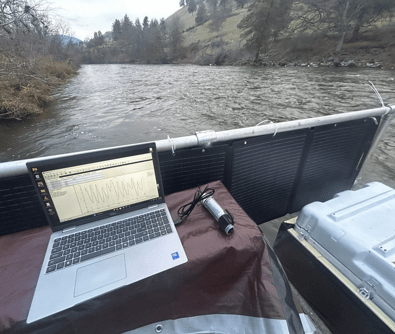
Results/progress toward objectives (current reporting period): The project was initiated in spring 2025. During the recent migratory season, we collected 13 paired eDNA and tangle netting samples. Next migratory season (September–January), we will collect a minimum of 20 additional paired samples, resulting in a total of 33 or more paired samples. In September, we deployed an autonomous eDNA sampler to support comparisons with sonar-based observations. Since deployment, the system has collected 151 samples, and we have achieved 84% day-level sampling coverage. Autonomous sampling will continue through December 2026. To date, 203 samples have been processed and DNA has been extracted. Extracted samples will be analyzed using species-specific quantitative PCR (qPCR) assays targeting Chinook salmon (Oncorhynchus tshawytscha), coho salmon (O. kisutch), steelhead (O. mykiss), and Pacific lamprey (Entosphenus tridentatus). Optimization of the qPCR assays for all four target taxa is underway; upon completion, qPCR analysis of this season’s extracted samples will begin.
Management implications: These results will provide a field-based evaluation of eDNA as a fisheries monitoring tool and will inform method selection and study design for anadromous fish monitoring. In particular, the work will help determine when eDNA can complement or replace conventional approaches, potentially reducing logistical constraints, field effort, and reliance on capture-based approaches.